Elicit AI Review 2025: Complete Guide to the AI Research Assistant
Overview
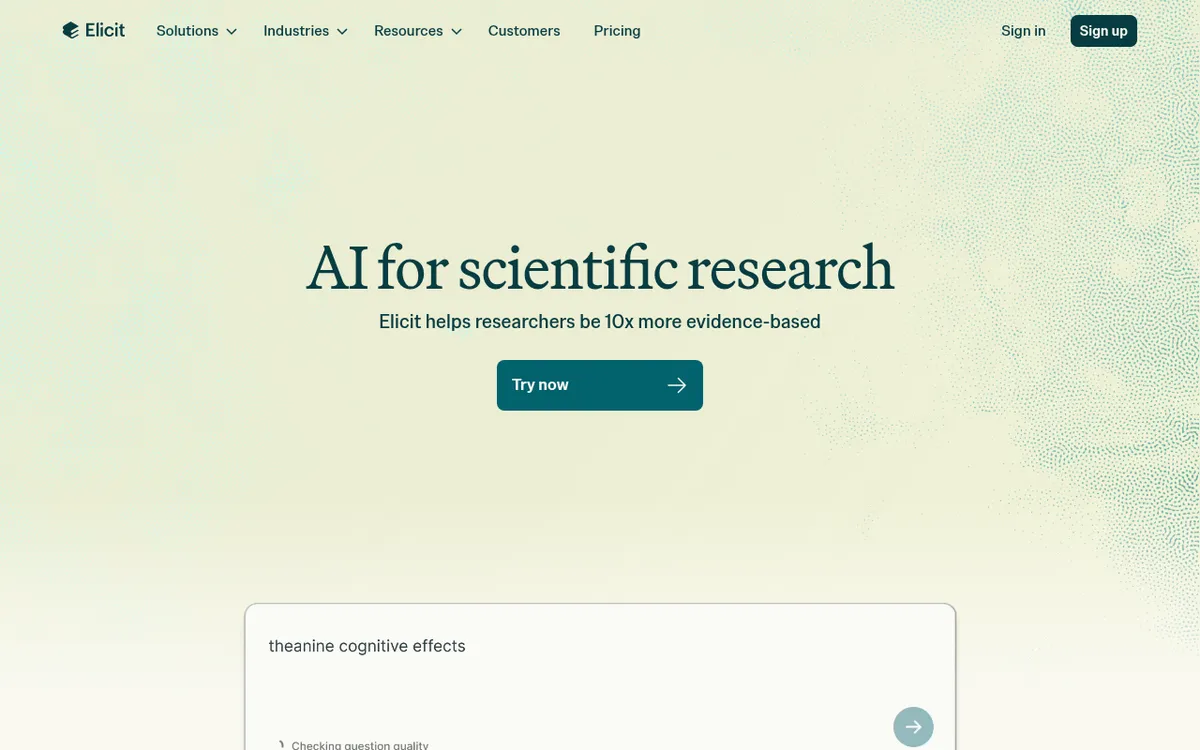
Elicit is an AI-powered research assistant designed specifically for scientific research and literature reviews. Developed to help researchers find papers, extract data, and synthesize evidence across millions of academic sources, Elicit stands apart from general-purpose AI tools by focusing exclusively on structured, evidence-based reasoning.
Key Stats (2025):
- 5+ million researchers worldwide
- 138 million academic papers indexed
- 545,000 clinical trials searchable
- 99.4% data extraction accuracy (verified case study)
- Up to 80% time savings on systematic reviews
- Used by institutions including MIT, Stanford, Harvard, and top pharmaceutical companies
Company Background
Founding & Mission
Elicit was co-founded in 2018 by Andreas Stuhlmüller (CEO) and Jungwon Byun (COO) with a mission to scale up good reasoning using machine learning. The platform originated within Ought, a non-profit machine learning research lab, before spinning off as an independent public benefit corporation in 2023.
Andreas Stuhlmüller brings deep expertise in automating reasoning, holding a Ph.D. in Cognitive Science from MIT and postdoctoral research at Stanford focusing on computation and cognition.
Jungwon Byun contributed her experience in growth and operations from her tenure as Head of Growth at Upstart and consulting at Oliver Wyman, with an economics degree from Yale.
Funding & Growth
- September 2023: $9M seed round led by Fifty Years
- February 2025: $22M Series A co-led by Spark Capital and Footwork
- Total Funding: ~$31M+
- Notable Investors: Tom Preston-Werner (GitHub co-founder), Arash Ferdowsi (Dropbox co-founder), Jeff Dean (Google Chief Scientist), Thomas Ebeling (former Novartis CEO)
The company has grown to over 400,000 monthly active users, tens of thousands of paying subscribers, and millions in annual recurring revenue—all through word-of-mouth growth.
Headquarters: Oakland, California, USA
Core Features
1. Semantic Search
Elicit's semantic search goes beyond traditional keyword matching to understand research context and relationships.
Capabilities:
- Search across 138 million academic papers
- 545,000 clinical trials from ClinicalTrials.gov
- Semantic understanding finds relevant papers without perfect keyword matches
- Filter by methodology, publication date, and citation impact
- Find up to 1,000 relevant papers per query
2. Research Reports
Introduced in February 2025, Elicit Reports generate automated research overviews based on systematic review principles.
Features:
- Fully automated rigorous research briefs
- Deeply customizable—change which papers and information appear
- Built on systematic review methodology
- Sentence-level citations for every AI-generated claim
- Quality evaluated to outperform other deep research tools
3. Systematic Literature Review
Elicit's most advanced workflow, delivering human-level accuracy in evidence synthesis.
Capabilities:
- Guided step-by-step process for search, screening, and data extraction
- Automate screening and data extraction phases
- Up to 80% time savings compared to manual reviews
- Process up to 20,000 data points at once
- Support for keyword search over Elicit, PubMed, and ClinicalTrials.gov (added October 2025)
Transform hundreds of papers into structured, analyzable data.
Features:
- Extract specific information (population, intervention, outcomes, sample size)
- Organize into customizable, interactive tables
- Up to 20 columns for data extraction (Pro plan)
- Quantitative and qualitative data from PDFs
- All extracted data includes exact citations
5. Library
Personal research organization system.
Features:
- Store and organize sources across projects
- Easy reuse in future research
- Build knowledge base over time
6. Alerts
Stay current with evolving research without inbox clutter.
Features:
- AI-powered relevance filtering
- Surface relevant research automatically
- Reduce time wasted on irrelevant papers
- Personalized research monitoring
How Elicit Works
Unlike general-purpose chatbots, Elicit employs a methodology inspired by systematic reviews:
- Decomposition: Complex research questions are broken into smaller, manageable subtasks
- Search: Semantic search identifies relevant papers from 138M+ sources
- Extraction: AI extracts key information with sentence-level citations
- Synthesis: Findings are organized into tables, reports, or summaries
- Verification: Every claim links to source quotes for human verification
This approach emphasizes supervising the process rather than just the outcome, making AI reasoning transparent and trustworthy for academic use.
Pricing Plans (2025)
Basic (Free)
- Unlimited search across 138M+ papers
- Unlimited chat/summaries (4 papers at once)
- Data extraction from 20 PDFs/month
- Basic relevancy ranking
- Best for: Casual exploration, students
Plus — $12/month ($120/year)
- Data extraction from 50 PDFs/month
- Chat with up to 8 full-text papers
- Up to 5 columns in data extraction tables
- Unlimited table exports
- High-accuracy columns feature
- Best for: Independent researchers
Pro — $49/month ($499/year)
- Data extraction from 200 PDFs/month
- Up to 20 columns per table
- Guided systematic review workflow
- Comprehensive reporting features
- Personalized research alerts
- Best for: Professional researchers, systematic reviews
Team/Enterprise — Custom Pricing
- Data extraction from 300+ PDFs/month
- Collaborative features
- Custom workflows and data sources
- Integration with institutional subscriptions
- Priority support
- Best for: Research teams, institutions, pharmaceutical companies
Industries Served
Pharmaceuticals
Accelerate drug development by quickly assessing clinical trial definitions and literature evidence.
Example: Formation Bio used Elicit to assess knee osteoarthritis definitions across 1,600 papers, achieving 10x faster results than manual review.
Academia
Support graduate students, professors, and research teams in pushing scientific frontiers.
Medical Devices & Technology
Design safe, effective products with comprehensive evidence review.
Policy & Government
Make evidence-based policies with rigorous research synthesis.
Consumer Goods
Improve products using scientific evidence across 8 of top 10 global pharmaceutical companies through partners like Oxford PharmaGenesis.
Industrials
Discover new materials and engineer solutions at scale.
Software & Technology
Innovate on user experience, algorithmic performance, and more.
Case Studies & Accuracy
VDI/VDE German Education Policy
- Used Elicit for systematic review informing education policy
- 99.4% data extraction accuracy (1,502 of 1,511 data points correct)
- 11x more evidence considered than traditional methods
- Assessed knee osteoarthritis definitions in clinical trials
- Processed 1,600 papers
- 10x faster than manual methods
Oxford PharmaGenesis
- Advises 8 of top 10 global pharmaceutical companies
- Reviewed 500 papers across 40 research questions
- Unprecedented scale for literature reviews
2025 Updates & Releases
| Date | Feature | Description |
|---|
| October 23, 2025 | Keyword Search | Systematic Reviews support keyword queries over Elicit, PubMed, ClinicalTrials.gov |
| July 23, 2025 | Clinical Trials | Search 545,000+ studies, summarize into tables/reports |
| June 30, 2025 | Elicit Alerts | AI-powered research monitoring, reduces irrelevant notifications |
| March 18, 2025 | Systematic Review Evaluation | Published accuracy validation methodology |
| March 4, 2025 | Reports Evaluation | Demonstrated superior quality vs other deep research tools |
| February 26, 2025 | Elicit Reports | Automated research overviews based on systematic review principles |
| February 20, 2025 | Elicit Systematic Review | Turn months of manual work into minutes |
| February 2025 | $22M Series A | Funding to expand beyond academia |
Pros and Cons
Pros
✅ Exceptional Accuracy: 99.4% data extraction accuracy in verified studies
✅ Transparent Citations: Every AI claim backed by sentence-level quotes
✅ Massive Database: 138M papers + 545K clinical trials
✅ Purpose-Built: Designed specifically for research, not general chat
✅ Time Savings: Up to 80% reduction in systematic review time
✅ Scale: Process up to 20,000 data points at once
✅ Free Tier: Generous free plan for exploration
✅ Public Benefit Corporation: Mission-driven, not just profit-focused
✅ No Hallucination Chat: Batch processing approach reduces fabrication risks
✅ Continuous Improvement: Monthly NPS improvements, weekly feature releases
Cons
❌ Not Comprehensive Database: Doesn't replace traditional databases like PubMed/Embase for exhaustive searches
❌ PDF Extraction Limits: Free and entry-level plans have monthly caps
❌ Academic Focus Only: Not suitable for general knowledge questions
❌ Report Quality: AI-generated reports are drafts requiring expert editing
❌ Basic Quality Assessment: Doesn't automatically evaluate methodological quality
❌ Learning Curve: More complex than general chat interfaces
❌ No Mobile App: Web-only platform
❌ Pricing for Teams: Enterprise pricing requires custom quotes
Elicit vs Competitors
Elicit vs Consensus
| Feature | Elicit | Consensus |
|---|
| Focus | Deep analysis, systematic reviews | Quick Yes/No answers |
| Answer Style | Detailed summaries, structured data | Concise conclusions |
| Data Extraction | Extensive (up to 20,000 data points) | Limited |
| Quality Metrics | Basic relevancy | SJR rankings, SciScore |
| Best For | Comprehensive research, literature reviews | Quick fact-checking |
Elicit vs Semantic Scholar
| Feature | Elicit | Semantic Scholar |
|---|
| Core Function | Research automation | Paper discovery |
| Data Extraction | ✅ Built-in | ❌ Not available |
| AI Summaries | ✅ Detailed | ✅ Basic |
| Systematic Review | ✅ Guided workflow | ❌ Not available |
| Price | Freemium | Free |
Elicit vs Scite.ai
| Feature | Elicit | Scite.ai |
|---|
| Primary Function | Literature review automation | Citation analysis |
| Unique Strength | Data extraction, synthesis | Citation context (supporting/disputing) |
| Best For | Evidence synthesis | Verifying claims |
| Integration | Semantic Scholar | Multiple databases |
Elicit vs ChatGPT/Perplexity
| Feature | Elicit | General AI (ChatGPT/Perplexity) |
|---|
| Database | 138M curated academic papers | General web |
| Citations | Sentence-level, verifiable | Variable quality |
| Hallucination Risk | Low (batch processing) | Higher (conversational) |
| Data Extraction | Structured tables | Unstructured text |
| Systematic Reviews | ✅ Purpose-built | ❌ Not designed for |
Who Should Use Elicit?
Ideal Users
✅ Graduate Students — Writing dissertations, thesis research, finding relevant literature quickly
✅ Academic Researchers — Conducting literature reviews, staying current in their field
✅ Healthcare Professionals — Evidence-based medicine, clinical research
✅ Pharmaceutical Companies — Drug development, clinical trial analysis
✅ Policy Analysts — Evidence-based policy making
✅ Medical Device Companies — Regulatory compliance, safety evidence
✅ Systematic Review Teams — Meta-analyses, Cochrane-style reviews
✅ R&D Departments — Scientific literature monitoring
Not Ideal For
❌ Casual Users — Overkill for simple searches
❌ Non-Academic Research — Built specifically for scientific literature
❌ Those Needing Mobile Access — No dedicated mobile app
❌ Users Wanting Comprehensive Database Search — Should combine with PubMed/Embase
❌ Those Needing Automatic Quality Assessment — Requires manual critical appraisal
Tips for Getting Started
- Start with Free Tier: Test semantic search and basic features before committing
- Use Natural Language: Ask questions as you would to a colleague
- Leverage Data Extraction: Export to tables for meta-analysis preparation
- Combine Tools: Use Elicit for discovery, traditional databases for comprehensive searches
- Verify Citations: Always check sentence-level citations for critical claims
- Try Elicit Reports: Generate automated overviews for new topics
- Set Up Alerts: Stay current without manual searching
Security & Compliance
- SOC 2 Type II Certified: Enterprise-grade security compliance
- Data Encryption: Secure authentication and data handling
- Privacy-Focused: Compliant with industry-standard privacy protocols
- Public Benefit Corporation: Aligned with long-term societal good
Final Verdict
Rating: 4.6/5 ⭐⭐⭐⭐⭐
Elicit represents the gold standard for AI-assisted academic research tools. Its focus on transparency, accuracy, and systematic methodology sets it apart from general-purpose AI assistants. The sentence-level citations, 99.4% extraction accuracy, and purpose-built workflows make it indispensable for serious researchers.
The platform excels at automating the tedious aspects of literature reviews while maintaining the rigor required for academic work. The free tier is generous enough for exploration, while paid plans offer exceptional value for professional researchers.
Best For: Researchers, graduate students, pharmaceutical companies, policy analysts, and anyone conducting evidence-based systematic reviews.
The Bottom Line: If you're drowning in academic papers and need to synthesize evidence efficiently while maintaining scholarly standards, Elicit is the tool you need. It won't replace your critical thinking, but it will dramatically accelerate your research workflow.
Last Updated: December 2025
Sources: Elicit.com, TechCrunch, Dealroom, Tracxn, industry reviews