
About Consensus

Consensus is an AI research assistant specifically designed for academic literature search and analysis. It combines GPT-4 language models with purpose-built vector search technology to help researchers quickly navigate the growing body of academic literature by offering insights at both topic and paper levels. The platform focuses exclusively on peer-reviewed scientific literature, providing semantic search capabilities that match queries based on meaning rather than just keyword overlap. Key features include the Consensus Meter for gauging agreement/disagreement on research topics, Deep Search for detailed analysis, Pro Analysis with conversational prompts, and advanced filtering by journal rank, study design, and field of study. The tool excels at extracting essential information from collections of documents and presenting results as digestible summaries or detailed reports, making it invaluable for evidence-based research and literature reviews.

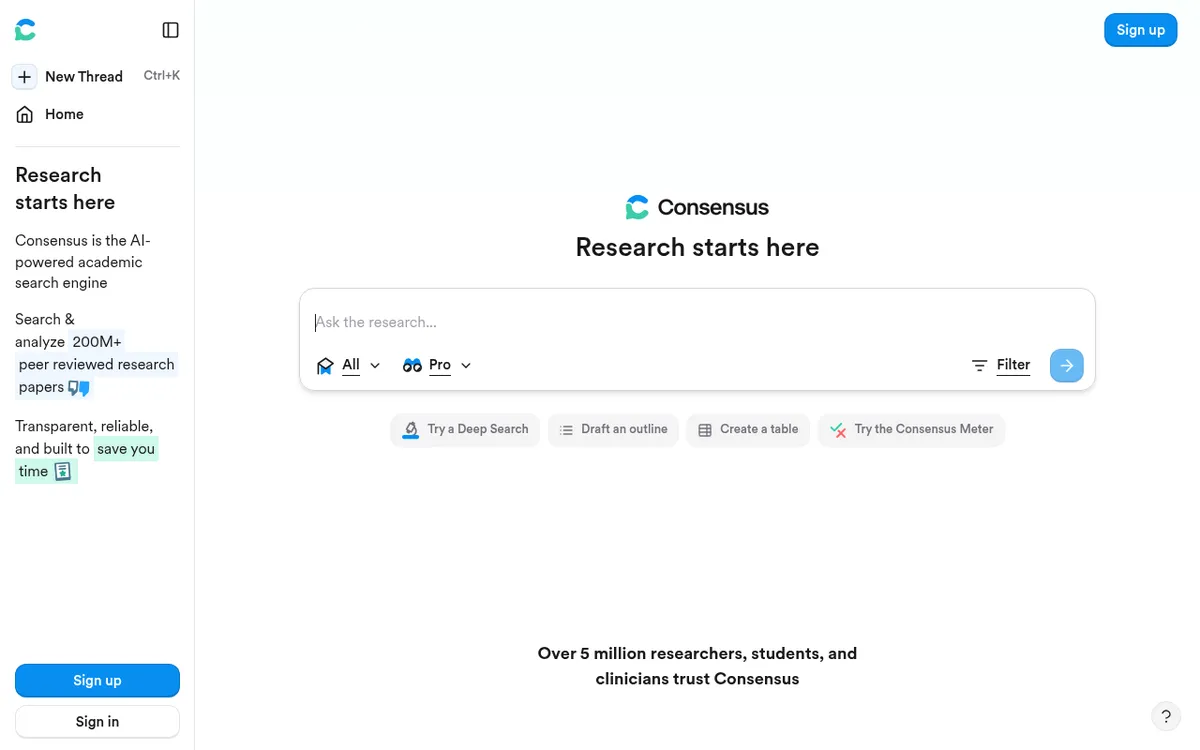
Screenshot of Consensus - AI-powered academic search engine. Finds and summarizes scientific research papers.
Click to expand

Pros & Cons

Pros

  • Focuses exclusively on peer-reviewed academic literature
  • Real citations with high accuracy from trusted sources
  • Consensus Meter visualizes agreement/disagreement on topics
  • Advanced filtering by journal rank and study design
  • Semantic search technology for contextually relevant results
  • Deep Search provides detailed analysis and summaries

Cons

  • Limited to academic literature only, not general knowledge
  • Restricted free tier with only 3 searches per month
  • May miss very recent publications
  • Less conversational than general-purpose AI tools

Best For

Academic researchers and scientists
Graduate students writing dissertations
Evidence-based practitioners
Clinicians seeking research support
Literature review authors
Deep Review

In-Depth Analysis of Consensus

A comprehensive look at features, pricing, and everything you need to know.

Consensus AI Review 2025: The Game-Changing Research Tool Every Academic Needs

In the fast-paced world of academic research, finding reliable, peer-reviewed sources has become increasingly challenging. With millions of research papers published annually, researchers and students often find themselves drowning in information overload, struggling to identify the most relevant and credible sources for their work.

Consensus emerges as a revolutionary solution to this problem. This AI-powered academic search engine transforms how researchers approach literature reviews by automating the most time-consuming aspects of academic research. Unlike generic AI tools that pull information from across the web, Consensus focuses exclusively on peer-reviewed scientific literature, ensuring every result meets rigorous academic standards.

In 2025, as the demand for evidence-based research continues to grow across disciplines, Consensus has positioned itself as an indispensable tool for academics, graduate students, clinicians, and evidence-based practitioners who need quick access to credible scientific information with proper citations and consensus tracking.

What is Consensus?

Consensus is a specialized AI research assistant that serves as a bridge between researchers and the vast world of academic literature. Built by a team focused on democratizing access to scientific knowledge, this platform leverages advanced technologies including GPT-4 and vector search technology to deliver semantically relevant research results rather than simple keyword matching.

The platform operates on Semantic Scholar's database, ensuring access to high-quality, peer-reviewed academic sources. What sets Consensus apart is its ability to not just find relevant papers, but to extract essential information, summarize findings, and present results in digestible formats that save researchers countless hours of manual review.

Unlike conversational AI tools designed for general queries, Consensus is purpose-built for academic research. It understands the nuances of scientific literature, maintains citation accuracy, and provides unique features like consensus visualization to help researchers understand the current state of knowledge on specific topics.

The creators designed Consensus to address a critical gap in the research workflow: the time-consuming process of literature review and the challenge of determining scientific consensus on complex topics. By automating these processes while maintaining academic rigor, Consensus has become an essential tool for modern research.

Key Features

FeatureDescriptionBenefit
Deep SearchAdvanced AI analysis that provides detailed, comprehensive reports on research topicsSaves hours of manual literature review with thorough, structured analysis
Consensus MeterVisual gauge showing agreement levels within research using Yes/No questionsQuickly identifies scientific consensus or controversy on specific topics
Pro AnalysisConversational prompts allowing customized output formats (tables, bullet points, etc.)Tailors results to specific research needs and presentation formats
Advanced FilteringFilter results by journal rank, study design, and field of studyEnsures research quality and relevance to specific academic disciplines
Semantic SearchVector-based search technology for contextually relevant resultsFinds papers based on meaning rather than just keyword matching
Citation AccuracyProper citations from peer-reviewed sources with direct linksMaintains academic integrity with verifiable, credible sources
Consensus VisualizationGraphical representation of research agreement and disagreementProvides clear visual understanding of scientific consensus
Literature ExtractionAutomated key information extraction from research collectionsStreamlines the research process with essential findings highlighted

How Consensus Works

Consensus simplifies the complex process of academic research through a streamlined workflow:

  • Enter Your Research Query: Input your research question or topic in natural language, focusing on academic subjects found in peer-reviewed literature.
  • AI Processing: The platform uses GPT-4 and vector search technology to analyze your query and search Semantic Scholar's extensive database of academic papers.
  • Semantic Matching: Unlike keyword-based searches, Consensus finds papers based on semantic similarity and contextual relevance to your query.
  • Results Filtering: Apply filters for journal rank, study design, publication date, and field of study to refine your results.
  • Information Extraction: The AI automatically extracts key information, findings, and conclusions from relevant papers.
  • Summary Generation: Receive digestible summaries or detailed reports through Deep Search functionality.
  • Consensus Analysis: View the Consensus Meter to understand agreement levels and scientific consensus on your topic.
  • Citation Access: Get proper citations and direct links to original papers for further investigation and verification.

Pricing & Plans

PlanPriceFeaturesBest For
Free Tier$0/month• 3 Deep Searches per month
• Limited Pro Analyses
• Basic search functionality
• Access to filtering options
Students and occasional researchers
Pro SubscriptionContact for pricing• Unlimited Deep Searches
• Unlimited Pro Analyses
• Full feature access
• Priority support
• Advanced customization
Regular researchers and professionals
Special Discounts Available:
  • Student Discount: Available with .edu/.ac email or proof of enrollment
  • Clinician Discount: Special rates for healthcare professionals
  • Academic Institution: Volume pricing for universities and research institutions
Value Analysis: While the free tier provides excellent value for getting started, the limited searches may quickly become restrictive for active researchers. The Pro subscription offers unlimited access to all features, making it worthwhile for anyone conducting regular literature reviews or academic research.

Pros and Cons

Pros

  • Academic Focus: Exclusively searches peer-reviewed, scientific literature ensuring credibility
  • Real Citations: Provides proper citations with direct links to original sources
  • Consensus Visualization: Unique feature showing agreement levels within research communities
  • Advanced Filtering: Comprehensive filters by journal rank, study design, and field
  • Semantic Search: Context-aware results rather than simple keyword matching
  • Time-Saving: Automates literature review processes that typically take hours
  • Deep Analysis: Comprehensive reports with extracted key information
  • User-Friendly: Intuitive interface accessible to researchers at all levels

Cons

  • Limited Scope: Restricted to academic literature only, not suitable for general queries
  • Free Tier Restrictions: Only 3 searches per month may be insufficient for active researchers
  • Recency Gaps: May miss very recent papers due to database update delays
  • Less Conversational: Not as interactive as general-purpose AI chatbots
  • Pricing Transparency: Pro subscription pricing not publicly available
  • Learning Curve: Requires understanding of academic research terminology for best results

Who Should Use Consensus?

Academic Researchers


Perfect for professors, postdocs, and research scientists who need comprehensive literature reviews and consensus analysis for grant applications, research papers, and systematic reviews.

Graduate Students


Invaluable for thesis research, dissertation literature reviews, and coursework requiring credible academic sources with proper citations.

Evidence-Based Practitioners


Ideal for healthcare professionals, policy makers, and consultants who need quick access to research evidence to support decision-making.

Clinicians and Healthcare Professionals


Excellent for medical professionals seeking current research on treatments, interventions, and clinical best practices.

Literature Review Authors


Essential for researchers conducting systematic reviews, meta-analyses, or comprehensive literature surveys.

Research Librarians


Helpful for information professionals assisting researchers and students with complex literature searches.

Consensus vs Alternatives

FeatureConsensusSciSpaceResearchGateGoogle Scholar
AI-Powered Analysis Advanced Good Limited None
Consensus Tracking Unique Feature No No No
Citation Quality Excellent Good Good⚠️ Variable
Filtering Options Comprehensive Good⚠️ Limited⚠️ Basic
Literature Extraction Automated AI-Assisted Manual Manual
Free Tier⚠️ Limited More Generous Free Free
Academic Focus Exclusive Primary Exclusive Primary
Key Differentiators: Consensus stands out with its unique Consensus Meter feature and exclusive focus on extracting insights from collections of papers rather than individual document analysis.

Tips for Getting Started

1. Start with Specific Research Questions


Frame your queries as focused research questions rather than broad topics. Instead of "climate change," try "How does carbon pricing affect renewable energy adoption?"

2. Leverage the Consensus Meter


Use Yes/No questions to quickly gauge scientific consensus. Ask questions like "Does meditation reduce anxiety?" to get immediate consensus insights.

3. Utilize Advanced Filters


Apply journal rank and study design filters early to ensure you're getting high-quality, relevant results for your specific research needs.

4. Experiment with Pro Analysis Prompts


Try different conversational prompts like "create a table," "summarize in bullet points," or "explain for a general audience" to customize outputs.

5. Combine with Traditional Methods


Use Consensus as a starting point, then dive deeper into the most promising papers it identifies for comprehensive understanding.

6. Save and Organize Results


Keep track of your searches and results for future reference, especially when working on long-term research projects.

7. Verify Recent Developments


Cross-reference Consensus results with very recent publications, as there may be delays in database updates for cutting-edge research.

Final Verdict

Overall Rating: 4.2/5 ⭐⭐⭐⭐

Consensus represents a significant leap forward in academic research tools, offering capabilities that were unimaginable just a few years ago. Its AI-powered approach to literature review, combined with unique features like the Consensus Meter, makes it an invaluable asset for anyone engaged in evidence-based research.

Strengths: The platform excels in automating time-consuming research tasks while maintaining academic rigor. The exclusive focus on peer-reviewed literature, advanced filtering options, and consensus visualization features set it apart from both general AI tools and traditional academic databases. Areas for Improvement: The restrictive free tier and lack of transparent pricing may limit accessibility for some users. Additionally, the academic-only focus, while being a strength, also limits its versatility compared to more general research tools. Recommendation: Consensus is highly recommended for academic researchers, graduate students, and evidence-based practitioners who regularly conduct literature reviews. While the free tier is somewhat limiting, the Pro subscription appears to offer excellent value for active researchers who need comprehensive, AI-powered literature analysis. Ready to revolutionize your research workflow? Try Consensus today and experience the future of academic literature review. Start with the free tier to explore its capabilities, and consider upgrading to Pro if you find yourself reaching the search limits quickly. The investment in Consensus could save you countless hours of manual literature review while improving the quality and comprehensiveness of your research – making it one of the most valuable tools in any serious researcher's toolkit.